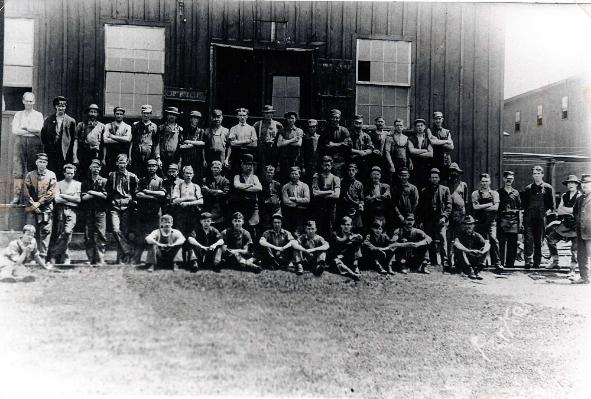
History of Portville's Tanneries
(as Remembered by Dutch Marsh)
(as Remembered by Dutch Marsh)
I would like to tell of some of the industries I have seen come and go in Portville. First, and probably
oldest to me was the old tannery that was located where the Ice Cream Plant is now on upper Temple
Street. This was a large factory manufacturing some leather which was tanned with liquor made
from hemlock bark from the surrounding forest. I can remember when we could look out most any
time and see a load of bark going by on bark wagons. There were no good roads then and there was
lots of mud some parts of the year. Years before I was born, they had to haul the finished leather to
Olean to ship by Erie Railroad, but after that, the Western New York and Pennsylvania Railroad was
built and the leather was shipped out of Portville.
There was an office building where Vic Anderson now lives (76 Temple Street), with rows and rows
of bark piled out back. The foot swing bridge now located across from the Cemetery was, in those
days, down the creek farther in back of the tannery. This swing bridge was built so employees living
on Brooklyn Street could cross, and there were a lot of employees living there. Also, Charles Lewis
had a hair house across the creek (Dodge Creek) and the hair that came off the cow hides was saved,
washed and dried, and shipped away to make clothing. After the tannery closed, Mr. Lewis moved
his factory to the creek bank in back of his house off Temple Street, now known as Anderson Court.
After the old tannery was sold to a Trust Company and closed forever, the younger generation of
Wheeler and Dusenbury families formed a company and built a tannery on the land where the
Anderson Pattern Works is now located. This company came to be known as the Roulette Leather
Company, so named because they moved parts of a plant from Roulette, Pa., to Portville.
This plant turned out to be a great asset to the town because it employed, at times, as many as 250
people. At first, this plant used a bark liquor to tan the leather. This leather was used for the upper
part of the shoe and was much more pliable than sole leather, but the process was very slow. In the
first place, the bark which came in from the forest was cut in chunks about four feet long, piled up
and dried, and was then taken to the bark mill and ground up into small pieces a little larger than saw
dust. These ground particles were then put into large tanks full of hot water and steamed for several
days. This process was called leaching and the building used for it was called a leach house. It
contained several tanks of bark, all going on at the same time; they had to have vents in the roof to let
out the steam. After these particles of bark had cooked so long, the liquor or water was drawn off
and this was what they used to tan the leather with. The actual tanning process took even longer.
The tanning liquor was put into wooden vats about eight feet by eight feet by seven feet and set in the
ground with just the top sticking out. In larger tanneries, like Portville, there would be four or five
hundred of these vats. After the vats were filled with liquor, the hides, after the hair had been
removed, were fastened on sticks eight feet long and hung in these vats, maybe thirty-five or forty to
each vat. They would be left there for a long time and then moved over to other vats with a different
strength liquor. This lay-away process took as much as six months with the changes to various
strength bark water, but when it was finished, the leather was tanned and ready to be finished.
Later, the Roulette Leather Company sold their interests to the Northwestern Leather Company of
Boston, Mass. They did away with the bark tanning and used Chrome tanning. This process was
much quicker, and hides could be tanned in three or four days that used to take months. The leather
was used for very fancy upper parts of shoes, all colors and shades.
oldest to me was the old tannery that was located where the Ice Cream Plant is now on upper Temple
Street. This was a large factory manufacturing some leather which was tanned with liquor made
from hemlock bark from the surrounding forest. I can remember when we could look out most any
time and see a load of bark going by on bark wagons. There were no good roads then and there was
lots of mud some parts of the year. Years before I was born, they had to haul the finished leather to
Olean to ship by Erie Railroad, but after that, the Western New York and Pennsylvania Railroad was
built and the leather was shipped out of Portville.
There was an office building where Vic Anderson now lives (76 Temple Street), with rows and rows
of bark piled out back. The foot swing bridge now located across from the Cemetery was, in those
days, down the creek farther in back of the tannery. This swing bridge was built so employees living
on Brooklyn Street could cross, and there were a lot of employees living there. Also, Charles Lewis
had a hair house across the creek (Dodge Creek) and the hair that came off the cow hides was saved,
washed and dried, and shipped away to make clothing. After the tannery closed, Mr. Lewis moved
his factory to the creek bank in back of his house off Temple Street, now known as Anderson Court.
After the old tannery was sold to a Trust Company and closed forever, the younger generation of
Wheeler and Dusenbury families formed a company and built a tannery on the land where the
Anderson Pattern Works is now located. This company came to be known as the Roulette Leather
Company, so named because they moved parts of a plant from Roulette, Pa., to Portville.
This plant turned out to be a great asset to the town because it employed, at times, as many as 250
people. At first, this plant used a bark liquor to tan the leather. This leather was used for the upper
part of the shoe and was much more pliable than sole leather, but the process was very slow. In the
first place, the bark which came in from the forest was cut in chunks about four feet long, piled up
and dried, and was then taken to the bark mill and ground up into small pieces a little larger than saw
dust. These ground particles were then put into large tanks full of hot water and steamed for several
days. This process was called leaching and the building used for it was called a leach house. It
contained several tanks of bark, all going on at the same time; they had to have vents in the roof to let
out the steam. After these particles of bark had cooked so long, the liquor or water was drawn off
and this was what they used to tan the leather with. The actual tanning process took even longer.
The tanning liquor was put into wooden vats about eight feet by eight feet by seven feet and set in the
ground with just the top sticking out. In larger tanneries, like Portville, there would be four or five
hundred of these vats. After the vats were filled with liquor, the hides, after the hair had been
removed, were fastened on sticks eight feet long and hung in these vats, maybe thirty-five or forty to
each vat. They would be left there for a long time and then moved over to other vats with a different
strength liquor. This lay-away process took as much as six months with the changes to various
strength bark water, but when it was finished, the leather was tanned and ready to be finished.
Later, the Roulette Leather Company sold their interests to the Northwestern Leather Company of
Boston, Mass. They did away with the bark tanning and used Chrome tanning. This process was
much quicker, and hides could be tanned in three or four days that used to take months. The leather
was used for very fancy upper parts of shoes, all colors and shades.

| The Portville Historical and Preservation Society |
 |
| |
 |
| |
 |
| |
 |
| |
 |
| |
 |
| |
 |
| |
 |
| |
 |
| |
 |
| 17 Maple Avenue Portville, NY 14770 www.portvillehistory.org |
Portville, New York