
Social Life in Portville Fifty Years Ago (1892)
by Fanny B. Parish
by Fanny B. Parish
As I think back to the late eighties and early nineties, I realize
many changes have taken place in the home life and public life of
Portville.
Fifty years ago, the family was bound by closer ties. The Sunday
dinner, small neighborhood parties, Thanksgiving, and Christmas
were of interest to all the family. It was not difficult to find a
time when all the family could be present.
The services of the churches were better attended. An
opportunity to hear Bishop John H. Vincent was highly prized by
the whole community. The same was true of any noted preacher
or lecturer. There were no movies to divide the interest of the
family.
Singing schools were still in vogue. Everyone sang; no gathering,
large or small, was complete without a song; songs secular or
religious, or both. From “Hold the Fort” and “Gathering in the
Sheaves” to “White Wings” and “Annie Rooney.”
One of the pleasant memories of those days was a Philharmonic
Society organized by Mrs. W. B. Mersereau. Other events of
interest were a Shakespeare Club, of which Frank Wright was the
leading spirit; Chautauqua Reading Circles, a Travelers Club, led
by Rev. H. A. Reed; a Young Men’s Magazine Club, organized by
Rev. Sam Clark.
Each year, the community looked forward to a concert by the
Fish Jubilee Singers and other artists.
The school was in the old wooden building. Unpainted, wooden
stairs never seemed to bother any of us – but? A Debating Team,
organized by the Principal for the young men, and a Saturday
Afternoon Reading Circle for the girls, under Miss Edith Stevens,
filled a large place in the social life of the young people.
Gradually, our school has enlarged, more teachers hired, and
many courses added, until there is no comparison between 1892
and 1942.
The building of the Gymnasium has added much to the
recreational life of the community, and has taken the place of
sleighing, coasting, and skating parties.
I think of Portville of 1892 as a little more conservative. Then,
the ladies of forty went calling very regularly on certain fixed
days, wearing their pretty little bonnets, trimmed with flowers,
with ribbons tied under their chins. Now, the ladies just call each
other on the phone.
Perhaps you will not agree with me. Perhaps you think the
children of 1942 are dressed in a more conservative manner with
socks and low shoes, than bare foot boys and girls of 1892.
One thing, on which we all agree, is that Portville is a good place
in which to live. We will remember that our social life will depend
on our efforts to make pleasant social surroundings for others.
----Fanny B. Parish, September 1942
This column ran in the Portville Review newspaper.
many changes have taken place in the home life and public life of
Portville.
Fifty years ago, the family was bound by closer ties. The Sunday
dinner, small neighborhood parties, Thanksgiving, and Christmas
were of interest to all the family. It was not difficult to find a
time when all the family could be present.
The services of the churches were better attended. An
opportunity to hear Bishop John H. Vincent was highly prized by
the whole community. The same was true of any noted preacher
or lecturer. There were no movies to divide the interest of the
family.
Singing schools were still in vogue. Everyone sang; no gathering,
large or small, was complete without a song; songs secular or
religious, or both. From “Hold the Fort” and “Gathering in the
Sheaves” to “White Wings” and “Annie Rooney.”
One of the pleasant memories of those days was a Philharmonic
Society organized by Mrs. W. B. Mersereau. Other events of
interest were a Shakespeare Club, of which Frank Wright was the
leading spirit; Chautauqua Reading Circles, a Travelers Club, led
by Rev. H. A. Reed; a Young Men’s Magazine Club, organized by
Rev. Sam Clark.
Each year, the community looked forward to a concert by the
Fish Jubilee Singers and other artists.
The school was in the old wooden building. Unpainted, wooden
stairs never seemed to bother any of us – but? A Debating Team,
organized by the Principal for the young men, and a Saturday
Afternoon Reading Circle for the girls, under Miss Edith Stevens,
filled a large place in the social life of the young people.
Gradually, our school has enlarged, more teachers hired, and
many courses added, until there is no comparison between 1892
and 1942.
The building of the Gymnasium has added much to the
recreational life of the community, and has taken the place of
sleighing, coasting, and skating parties.
I think of Portville of 1892 as a little more conservative. Then,
the ladies of forty went calling very regularly on certain fixed
days, wearing their pretty little bonnets, trimmed with flowers,
with ribbons tied under their chins. Now, the ladies just call each
other on the phone.
Perhaps you will not agree with me. Perhaps you think the
children of 1942 are dressed in a more conservative manner with
socks and low shoes, than bare foot boys and girls of 1892.
One thing, on which we all agree, is that Portville is a good place
in which to live. We will remember that our social life will depend
on our efforts to make pleasant social surroundings for others.
----Fanny B. Parish, September 1942
This column ran in the Portville Review newspaper.

| The Portville Historical and Preservation Society |
 |
| |
 |
| |
 |
| |
 |
| |
 |
| |
 |
| |
 |
| |
 |
| |
 |
| |
 |

| Portville, NY 14770 www.portvillehistory.org |
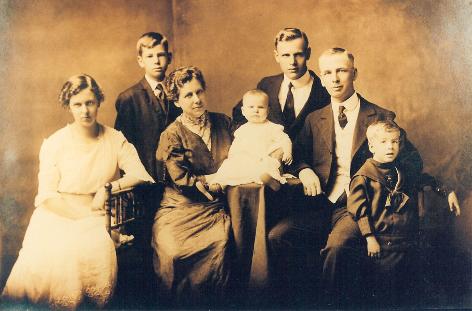
The author, Fannie Bell Parish, and her husband, Smith
Parish. The children are Ruth, David, Robert, Earl, and the
baby, Mary Isabel (who passed away just before turning ten)
Parish. The children are Ruth, David, Robert, Earl, and the
baby, Mary Isabel (who passed away just before turning ten)